We love Halloween (and Nevada Day) around here. My heart was full this year when J decided he wanted to be a scientist for Halloween. After all, scientists are the coolest superheroes of all!
Cute Scientist J
How not to sniff your experiments
Be safe, have fun, eat candy. I would love to see nerdy costumes if you have pics :-D
For every action, there's an equal and opposite reaction. The action is the chemical reaction between the vinegar and baking soda, which yields water and carbon dioxide (CO2) gas. The gas wants to escape, and giving it a little hole to escape, powers the bottle across the water (the reaction).
I did this experiment with the 3rd-5th graders in summer camp many moons ago. It wasn't exactly like this, as I don't remember the details. Luckily, there are plenty of sites out there to refresh my memory. I decided to approach it like I do cooking and looking up recipes online: a little from this recipe and a little from that recipe and add a few ingredients of my own.
Directions
Take an old 20oz soda bottle (I used a Diet Pepsi bottle from the power vote days) - the type of drink doesn't matter, though I don't recommend water bottles now that they are more eco-friendly and very squishable (yes, that's an official scientific term).
Dril a hole through the cap (about the size of a straw diameter).
Place about 10 marbles in the bottle to give it weight (since the bottle is buoyant when placed in the water).
Fill up the bottle ~1/4 with vinegar (just plain, cheap, generic name vinegar).
Add ~1T of baking soda to the bottle (other people suggest rolling the baking soda in toilet paper. This was VERY messy and frustrating though just dumping 1T of baking soda in the bottle was relatively painless). -This is a great use for your old baking soda that A&H recommends switching out soon with the time switch. **
Screw on the lid.
Cover the hole in the lid and shake the bottle.
Place the bottle in the water and watch it go!
Experiment
See if the shape of plastic bottle affects the motion (Mt Dew has a different shape than Diet Coke which has a different shape than Diet Pepsi).
Alter the ratio of baking soda-to-vinegar and see what happens (more/less vinegar and/or baking soda).
Race - you'd probably need a bigger tub than our small cooler.
Questions
What made the boat move?
What happened when I put this white powder (baking soda) into this bottle of vinegar (it's also good to ask beforehand too for a hypothesis)?
What would happen if I try this again but differently (your choice on different, or let your child experiment)?
What happens if we remove the marbles from the bottle?
What did the vinegar turn into after the addition of baking soda? (water + CO2 - but the CO2 is what powered your boat)
What else can make your boat move? (J liked using his hands)
**We've also used old baking soda down the drain and added vinegar. It magically unclogged our drain. Not as exciting to a little kid, but it saved us a trip to the store. Woohoo! Science!
J was getting antsy and instead of letting him destroy the house, I decided to build him a quick sail car.
And then he played around with it, even naming it "Lightning McQueen." My only guess for the name was due to how fast it went! Here's a video demonstration. Have your child blow as though they are blowing out candles on a birthday cake.
Main take away from lesson: for every action (blowing on the sail) there's an equal and opposite reaction (the car moves!).
Here's how you can make your own sail car out of recyclables.
Materials
Cardboard box (non-corrugated) - I used an empty contact solution box
2 wooden skewers (for kabobs, or in our case, chocolate fountain dipping)
Masking tape
Scissors
Directions:
Cut out the bottom of a box (keep it intact so you don't have to assemble a body of the car).
With the remainder of the box, I cut a sail and 4 circular wheels (I used small playdough containers to trace my circles).
Very carefully cut your skewers to a size where they'd make good axles for the car - cut off the pointy side too, for safety, while you are at it.
With the pointy side of the skewer, puncture your circles in the middle of the circle (don't hole punch these - you want them to be a tight fit on the skewer so they roll/move with the axle).
Attach one wheel to each circle.
Single hole punch 4 holes for the axles - 2 in the front and 2 in the back (make the holes relatively straight across from each other).
Insert the axles and attach the other wheels.
Position your wheels so they aren't touching the side of the car (friction) or falling off of the axles. You want them to be as straight as possible.
Tape the ends of your axles, so your wheels don't pop off.
With left over skewer parts (axle "rejects"), tape a piece of skewer to your sail and attach it to your car. I found masking tape works best.
Mark and X or put a sticker where you want your child to blow if they are having problems directing their sail car.
This to play around with
Shape of the sail
Direction of the sail
Where to blow on the sail (use a mini fan if your child can't blow hard enough)
Weight in car
Weight of car (downsize if it's not working)
Race your car(s) - who can go fastest/furthest with one blow?
Navigate your car through a maze
Decorate your sail car (not sciency, but keeps them out of trouble for a few more minutes and make it theirs)
I'd love to hear feedback of how your home sail car project went.
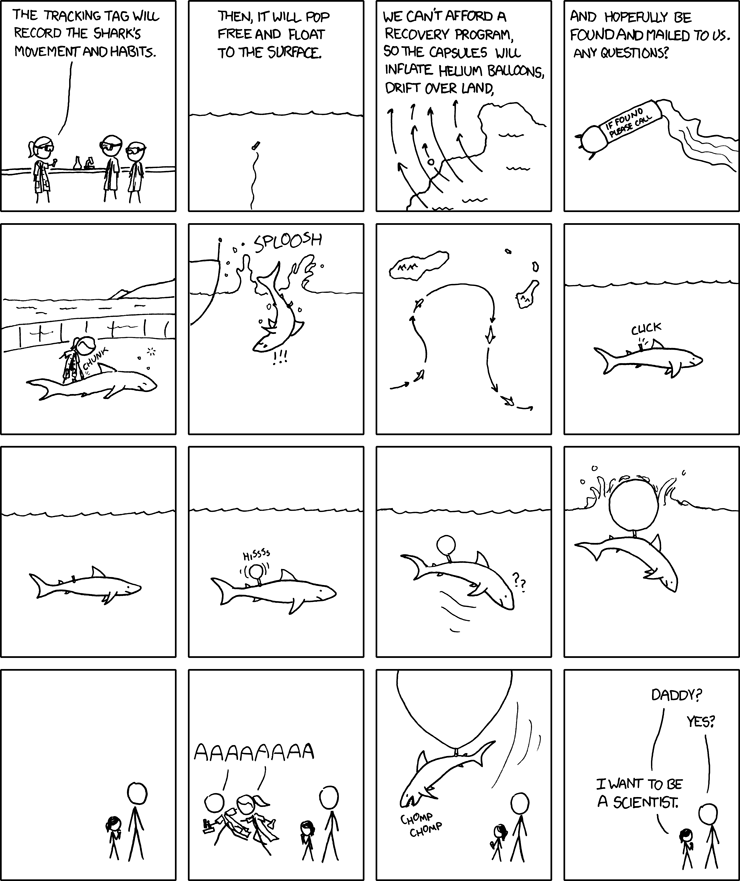
Yes, this xkcd comic is as old as J. However, we have it posted in my lab and it still makes me giggle whenever I read it. Scientists do some neat stuff!