One day, when Nerdy Science was a baby (ie. Nerdy Baby), I was at the park with my son trying to get the wiggles out after school, before coming home for dinner. I ran into a friend and was telling her about this brand new blog adventure and how I was getting little sleep between setting it up and J waking up between 4-5a (it was pretty awful). I guess the passion for this science blog showed through my words (and maybe my baggy eyes). Another person playing with her daughter happened to overhear and told me about Stroller Hikes, a non-profit organization that encourages family outdoor activities together. She had done some web work for the group and put me in touch with the organizer. I was hoping to help write some of their science curricula, but it turned out that I went into hyper drive with the Pepsi Refresh campaign, then the grant, and now Science Saturdays (sorry, Stroller Hikes). They still have tons of information for parents about fun activities in the outdoors, including science activities. I highly suggest checking them out whether you are a Bay Area Local or not.
Since our Science Saturdays happen to take place in local parks, I decided to see if they would be interested in our science activities. They wrote a fantastic blurb about Nerdy Science's Science Saturdays on their website. I look forward to meeting more parents as the activities continue. If you would like to join in on the Science Saturday fun, please email me using the link to the left and I'll add you to our email list. Since we depend on weather and our family's health, we can only predict about 5 days in advance when the next Science Saturday will be. So far, April's activity is looking like April 20th or 27th. Stay tuned.

Everyday science for families with young children.
Showing posts with label life science. Show all posts
Showing posts with label life science. Show all posts
Friday, March 8, 2013


Tuesday, September 11, 2012
Science at the beach
It was the same day as the aquarium trip. We may be home, but I'm still on vacation mode.
We took J to his first NorCal beach experience (we don't go that often since this Vegas girl can't do cold beaches).
Science you can do on the beach:
-- Guess how far the wave will come. We guessed based on the water line.

We guessed wrong:
-- Walk along the beach:

Compare foot sizes, step width, different walking patterns (bring a measuring device or an impromptu stick). Whose foot is bigger? Which is right/left? How do your footprints change with the way you walk? Then watch it all wash away with the waves.
-- Search for sea creatures, critters, fun birds, etc. Why do they look the way they do? What do they eat? What eats them? How are they affected by the waves or other sea animals?
Other things you can do at the beach:
We took J to his first NorCal beach experience (we don't go that often since this Vegas girl can't do cold beaches).
Science you can do on the beach:
-- Guess how far the wave will come. We guessed based on the water line.

We guessed wrong:
 |
| Whoops! |
-- Walk along the beach:

Compare foot sizes, step width, different walking patterns (bring a measuring device or an impromptu stick). Whose foot is bigger? Which is right/left? How do your footprints change with the way you walk? Then watch it all wash away with the waves.
-- Search for sea creatures, critters, fun birds, etc. Why do they look the way they do? What do they eat? What eats them? How are they affected by the waves or other sea animals?
 |
| It was nice of them to both pose |
Other things you can do at the beach:
- Talk about tides and their association with the moon. There are high tides, where the water comes up high on the beach, and low tides, exposing different parts of the beaches and often creatures and seashells. The tides are due to the interaction between the earth spinning and the gravitational forces of the moon and a little bit of the sun. If you stay long enough during your visit, you can see the differences in tides.
- Build sandcastles and other structures. Can they withstand the waves?
- Compare how you run on the sand to how you run on the sidewalk? Which one is easier? Which one is more difficult?
- Fly a kite. Which direction is the wind blowing? How high can you make it go?
- Hold a scavenger hunt. What's the most interesting thing you can find?
- Plan ahead and do a treasure hunt. Make and follow a map.
- Clean up the beach and talk about keeping the beaches clean so the sea animals can be happy and not swim in trash.
Hope your beach trip is also full of science goodness.
Friday, September 7, 2012
A trip to the Monterey Bay Aquarium
We took a break from at home science to venture out to a place J has never been before, The Monterey Bay Aquarium. I'll save you from the slideshow of family photos we took and stick to the science. Keep in mind, though I do specialize in "bio"mechanics, my marine biology knowledge ends with 6th grade life science and 9th grade biology.
J was drawn to the colorful exhibits, like the coral reefs. This one was fun because it used a magnifying glass enlarge pieces of the exhibit. J was mesmerized, as I think it was his first time realizing what magnifying glasses can do: little things look bigger!

Anything that he can touch instantly becomes his favorite. The touch pools were very nice. We talked mainly about starfish and how many legs they have, how they feel, where they live. In the pic below, he's touching an abalone.
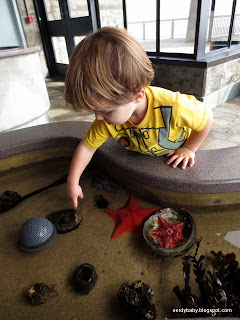
This is a starfish hiding in an old shell of an abalone. Some sea animals blend into their backgrounds as a survival tactic.

We fought the crowds for a front row seat at the penguin feeding. J was more interested in the penguins bathing themselves (they were easier to see swimming around and honestly were cuter than penguins eating). J picked up on the way penguins eat! He asked, "Mommy, why do they wiggle while they eat?" The answer - they don't chew their food and that's how they swallow the fish, whole. He raised his hand to ask the handlers a question but was never called on. He wouldn't tell us what he would have asked.

Speaking of feedings, we saw the Kelp Forest feeding, with lots of fish and small sharks. The questions J came up with basically revolved around why the diver looked like he did and why he was breathing funny.


I've always loved sea turtles, and this one seemed so friendly and playful. The children squealed with delight as they tried to reach the turtle who came down to visit a few times. It's amazing to compare their size to humans.

J was drawn to the colorful exhibits, like the coral reefs. This one was fun because it used a magnifying glass enlarge pieces of the exhibit. J was mesmerized, as I think it was his first time realizing what magnifying glasses can do: little things look bigger!

Anything that he can touch instantly becomes his favorite. The touch pools were very nice. We talked mainly about starfish and how many legs they have, how they feel, where they live. In the pic below, he's touching an abalone.

This is a starfish hiding in an old shell of an abalone. Some sea animals blend into their backgrounds as a survival tactic.

We fought the crowds for a front row seat at the penguin feeding. J was more interested in the penguins bathing themselves (they were easier to see swimming around and honestly were cuter than penguins eating). J picked up on the way penguins eat! He asked, "Mommy, why do they wiggle while they eat?" The answer - they don't chew their food and that's how they swallow the fish, whole. He raised his hand to ask the handlers a question but was never called on. He wouldn't tell us what he would have asked.

Speaking of feedings, we saw the Kelp Forest feeding, with lots of fish and small sharks. The questions J came up with basically revolved around why the diver looked like he did and why he was breathing funny.

Answers: Why do divers wear a mask and make funny noises? People need air to breathe, and we can't breathe air in the water. The diver brings in air from above in the form of a tank on his back. His mask is attached to this air, allowing him to breathe. The funny noises come from the way people breathe using a tank magnified by the microphone the diver was using to communicate to the volunteer during the feeding.
Why do divers look the way they do? (This was actually in the form of about 10 questions on why the diver was wearing gloves, pants, etc.) I had to remind J, "How did the water feel when you were touching the starfish?" Ocean water is cold. The wetsuit + gloves helps keep the divers warm.
Why does the diver have flippers? To help them swim.
The jellies are my favorite, so I'll stick them in here and give a shout-out to my mom who was on the 2nd season of Family Feud and answered, "What animal can kill with its bite?" with, "Jellyfish!" She got X'ed and still gets a hard time from her family (and us). However, jellyfish can be extremely dangerous (though I wouldn't say they "bite"). I personally love their angelic motion through the water (of course in the exhibit - I have yet to encounter one in the wild).

The following picture was a fun site. I apologize for quality of the photo, as the exhibit was dark and the fish and hammerhead shark was at the bottom of the exhibit. J was the first to spot the shark. Then it was fun to see the shark always have a circle around him that was fish-free (smart fish). It was an excellent opportunity to bring up the food chain and that animals eat other things and animals to help them grow and stay alive.

I've always loved sea turtles, and this one seemed so friendly and playful. The children squealed with delight as they tried to reach the turtle who came down to visit a few times. It's amazing to compare their size to humans.
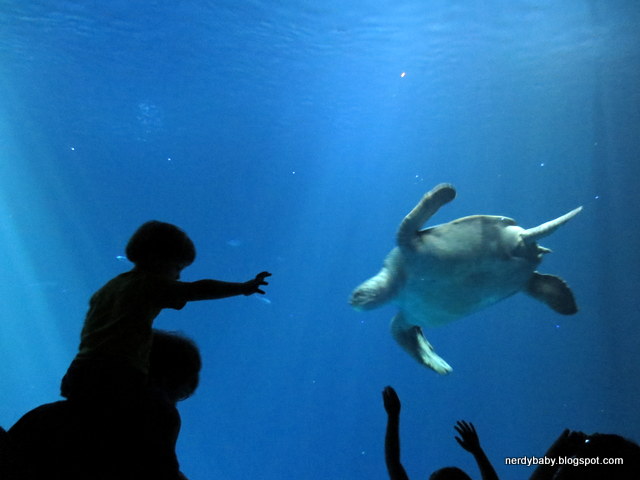
We hope you enjoyed our field trip to Monterey Bay. We had so much fun.
Tuesday, May 29, 2012
Lizards!
Now that I've been here for 7 years and still have yet to do many things in our backyard, I've started a bucket list for things I should do while living in the Bay Area. One of those things I've wanted to do but never have gotten around to was walking the Stanford Dish.
Well, Big J wanted to go for a family hike, so I suggested this as a starter hike (we haven't been hiking as a family - plus, it's something I've wanted to do).
The day was gorgeous and so was the view (which the cellphone camera picture doesn't do it justice).

Here's the Dish:

Yes J stayed on Big J's shoulders most of the hike.
Anyways, we had more fun science lessons while hiking. We were counting the animals we saw.
Squirrels: 20
Lizards: 10
Ladybugs: 3
Deer: 1
J has never been close to lizards before. We were this close to most of them:
Since J was fascinated by the lizards, I figured it was time to dust off my Desert Discoveries "star student" skills from the 7th grade (over 15 yrs ago) and give him some science info to keep him engaged. Like our 2-minute lady bug lesson, here's what our 2-minute lizard lesson sounded like:
I've started a 2-minute lesson tag for our unanticipated science lessons and quick general knowledge recaps. I'm sure there will be plenty more as we discover the world through the eyes of a preschooler (man, time flies).
5/29/12 edit
**Let me clarify. The Bay Area is not desert - we get ~15" of rain/year, which is more than the 10" or less to classify an area desert climate. However, lizards inhabit both climates. I know about them through science, but I think I learned more about them through Desert Discoveries, an elective I got placed into because my school was overcrowded and they were making up classes.
Well, Big J wanted to go for a family hike, so I suggested this as a starter hike (we haven't been hiking as a family - plus, it's something I've wanted to do).
The day was gorgeous and so was the view (which the cellphone camera picture doesn't do it justice).

Here's the Dish:

Yes J stayed on Big J's shoulders most of the hike.
Anyways, we had more fun science lessons while hiking. We were counting the animals we saw.
Squirrels: 20
Lizards: 10
Ladybugs: 3
Deer: 1
J has never been close to lizards before. We were this close to most of them:
 |
| Taken with a crappy cellphone with no zoom |
Since J was fascinated by the lizards, I figured it was time to dust off my Desert Discoveries "star student" skills from the 7th grade (over 15 yrs ago) and give him some science info to keep him engaged. Like our 2-minute lady bug lesson, here's what our 2-minute lizard lesson sounded like:
- Lizards are reptiles (compared to humans which are mammals or frogs which are amphibians).
- Lizards are cold-blooded, which means they are the temperature of their surroundings. These lizards were on the blacktop/pavement because they were trying to warm up. The pavement in the sun is warmer than the bushes in the shade. Comparison: humans are warm blooded, we stay ~98-99 degrees F.
- These lizards camouflaged themselves to their surroundings. We saw quite a few run into bushes and we had to look really hard to see them. They looked a lot like the dried up sticks that surrounded them.
- These lizards were chasing and eating ants. Mmmmm, crunchy.
- Lizards are quick when they run. It helps them get away from anything that might be wanting to eat or step on them.
- Lizards lay eggs.
I've started a 2-minute lesson tag for our unanticipated science lessons and quick general knowledge recaps. I'm sure there will be plenty more as we discover the world through the eyes of a preschooler (man, time flies).
5/29/12 edit
**Let me clarify. The Bay Area is not desert - we get ~15" of rain/year, which is more than the 10" or less to classify an area desert climate. However, lizards inhabit both climates. I know about them through science, but I think I learned more about them through Desert Discoveries, an elective I got placed into because my school was overcrowded and they were making up classes.
Thursday, April 5, 2012
See through eggs!
Yesterday, I explained how to peel a hard boiled egg without using your hands. I found a link on Pinterest that had a picture of a see-through egg (initially the link was broken but I just found a good link after our experiment was over).
Pour enough vinegar to cover a egg in a clear glass. Carefully add the raw egg. Wait 4 days. Rinse egg to get the excess shell/foam off. And this is what you get:
It's so neat to see inside of an egg! The texture of the egg is squishy, bouncy, and pretty fun. The yolk also still moves inside. I think it's pretty cool!
**Warning: this started out as a raw egg and sat out for 4 days (in vinegar), so if and when you handle it make sure to wash your hands and any surfaces it touches immediately.
Pour enough vinegar to cover a egg in a clear glass. Carefully add the raw egg. Wait 4 days. Rinse egg to get the excess shell/foam off. And this is what you get:
It's so neat to see inside of an egg! The texture of the egg is squishy, bouncy, and pretty fun. The yolk also still moves inside. I think it's pretty cool!
**Warning: this started out as a raw egg and sat out for 4 days (in vinegar), so if and when you handle it make sure to wash your hands and any surfaces it touches immediately.
Sunday, December 4, 2011
Bugs!
We had a chance for some quiet family time over Thanksgiving weekend. We decided to introduce J to board games and pulled out our cheap MB games that we rescued from our parents houses when we "grew up" and officially moved out.
The first one we pulled out was my Giant Cootie! The pieces are large enough that I don't have to worry about my 2.5 yr old choking.

We explained a little bit of insect anatomy as we built our bugs (the competition part of the game still is a bit above J's level).
Insects have:
Other things to discuss:
Other things to try:
**I don't think MB currently sells Giant Cootie (mine has a copyright of 1986 on the box), but they sure do have regular Cootie (which we also have an updated version from John's family). I did some internet research over the weekend and they were half off at many toy shops (prob due to Black Friday sales), but they typically run ~$10 non-sale.
The first one we pulled out was my Giant Cootie! The pieces are large enough that I don't have to worry about my 2.5 yr old choking.

We explained a little bit of insect anatomy as we built our bugs (the competition part of the game still is a bit above J's level).
Insects have:
- A head
- A thorax (middle section)
- An abdomen (the rear section)
- Six legs
- Two antennae
- Eyes
Other things to discuss:
- Where do insects come from?
- What purposes do insects serve?
- What are helpful insects?
- What are harmful insects?
- What do insects eat?
- What eats insects?
- How do insects protect themselves? - We discussed this one as a grasshopper hopped a ride on our car home from church two weeks ago. It was a giant grasshopper that resembled a leaf! (Sorry, I don't have a picture).
Other things to try:
- Collect a bug from outside and study it. Point out the features you just discussed and release it back into the "wild".
- Visit a museum with a bug collection on display to see a variety of shapes, sizes, colors, and kinds of bugs.
**I don't think MB currently sells Giant Cootie (mine has a copyright of 1986 on the box), but they sure do have regular Cootie (which we also have an updated version from John's family). I did some internet research over the weekend and they were half off at many toy shops (prob due to Black Friday sales), but they typically run ~$10 non-sale.
Subscribe to:
Posts (Atom)