Showing posts with label math. Show all posts

Sunday, March 22, 2015

Ultimate Pi Day Party! 3-14-15 9:26:53

Last week, we celebrated the Ultimate Pi Day (3.141592653...) with a Pi Party in the park. We had 20-30 people attend and had so much fun! Here's our Pi(e) spread complete with many homemade and store bought pies.


One of our nerdy attendees made this sign by the pie. Do you get it? Also, our local grocery store got in on the Pi Day fun...notice the price of the mini pie?


We lined the other tables with butcher paper and traced circles for Pi Day Posters and Investigating Pi. One of the attendees decided to reverse my investigating pi lesson to measuring the circumference with a string and seeing how many times she could measure the diameter from the circumference string (a little more than 3). The kids were more excited about the Pi-rate Treasure Hunt! Who can blame them?


Pi-rate booty!

Pi-rate Treasure Hunt:

I printed out an aerial Google Map of the park with clue #1 marked. The park where we had the event had a walking path, so I stuck the clues in obvious places along the path for the problems. Hints were more hidden, so the participants had to actively look for those if they needed the help. The kids had to answer 5 questions (preferably from the same set of questions) to get a prize from the treasure chest.

I had three levels of math problems for the kids to find and solve. I cut and pasted the problems onto colorful 3x5 cards:

Easy (green): Preschool
Medium (orange): k-2 grade
Hard (pink) = 3 grade+

Then I had some problems for adults (yellow) who might have accompanied their kids around. Those were more high school math, up to pre-algebra.

Here are the problems I came up with (note, my goal was to not make anyone cry).

Easy Pi-rate treasure hunt problems
Medium Pi-rate treasure hunt problems
Hard Pi-rate treasure hunt problems
Pi-rate treasure hunt problems for the adults

How did you fare on the Pi-rate Treasure Hunt questions?

How did you celebrate the Ultimate Pi Day??


Just for fun, here's our annual Pi Day Family Photo:


And one of the kids and me:


Previous years' Pi Day Photos.

Thursday, March 12, 2015

Pi-rate Treasure Hunt

Guess what?? Pi Day is my favorite nerdy holiday! My favorite activity so far has been celebrating with a Pi Party in the park. We made Pi Day Posters and Investigated Pi (and ate pie, but that's a normal Pi Day activity). Along with that fun, I created a treasure map and some fun math questions and sent the kids on a Pi-rate Treasure Hunt!


I used a screenshot of the park on Google Maps using the satellite feature and marked a path for the treasure hunt. I had five stops along the treasure hunt, each stop had four different levels of math questions. Clues to solving the problems if they needed help were hidden nearby, so they had to look for them if they really wanted the help. The fifth problem was at a treasure chest. After solving that problem, the kids received a small prize (leftover party goodies, like mardi gras beads and silly glasses from years of storage). (Note: edited 2/27/17 to past tense and linked to the math problems).

Easy - 3-5 year olds (preschool)
Medium - 5-7 year olds (k-2nd)
Hard - 7-9 year olds (3-4th)

And just for the adults to play alongside their kiddos:
Adult - Trig and pre-calculus level - brush up on your equations :-)

Happy Almost Pi Day to you!!

Related Post:
Ultimate Pi Party - pictures of our treasure hunt included!

Friday, January 23, 2015

Acute Baby

I saw a design similar to this onesie when I was pregnant with Miss Baby J. We are kind of maker-type people (when we have the time). I put it on my list of things I want to make her, but I figured that I'd never get to it (much like updating this blog, which sat lonely for a few months while I was trying not to drown).

Anyways, I had a few days over winter break to create my own shirt. I dyed a white body suit purple and drew the design in Inkscape before John helped me convert it into a digital file that is compatible with an embroidering machine. It's fun to have unique, nerdy pieces, and "acute" model to wear them:


Wednesday, September 10, 2014

Card games for preschoolers

With the new baby, we've been spending a lot of time at home and encouraging quiet activities. Being from Vegas, I have more than my fair share of cards, but J recently received a Batman deck for his birthday, which increased his interest in card games. Here are a few of our favorites so far and the skills that they teach the players.


Go Fish!:
How to play: Shuffle the deck of cards. Each person gets 5 cards, and the rest of the cards go in a pile in the between the players. The players look at their cards (not showing their cards to opponents), and if they have any matches, the players put them face up in front of them. The players then take turns asking one another if they have a card that would match a card that is currently in their hands. If the person asked has the card, they forfeit (give) the card to the asker, and the asker gets to go again. If the person asked does not have the card, they say, "Go fish!" and the asker picks from the pile of cards in between them. We play a variation that if the person draws the card that they just asked for from the "Go fish!" pile and gets that match, they get to go again. We play until one player gets rid of all of his/her cards. Then we count everyone's matches, and the person with the most matches win!
Skills: Matching is important in science, especially biology with classification of species. Go Fish! also teaches the mathematical skill of strategy where the players have to listen and remember who asked for which cards. The players want the most matches.

War:
How to play: Shuffle the deck of cards. All of the cards get evenly distributed between the players (2-4). The cards are placed face down in a stack in front of each player. Nobody looks at their cards. Each player then holds their deck of cards face down and places the top card from their deck face up in the play area, in between the players. The player who drew the largest card gets the cards in that round (which the won cards go face down into a pile/stack in front of the player, when a player gets to the end of his/her deck, he/she picks up and shuffles the cards in front of him/her and resumes drawing his/her cards). If the largest card is a tie, the players go into "War" which requires the tied cards' players to place 3 cards face down (they put down 1 card per syllable while saying "I declare") and then one card face up (saying "war!"). The person with the largest face up card gets all of the cards that round. If it's tied again, repeat "War" until someone gets a larger card. All  number cards (2-10) have face value, and then the face cards are greater than number cards. The order of face cards are Jacks < Queens < Kings < Aces. Repeat the drawing/collection of cards/War until one player has all of the cards (the winner has all of the cards).
Skills: War teaches the mathematical skill of greater than/less than. This is a game of chance. It all depends on the cards the dealer gives whoever is playing. You aren't allowed to peak at your cards, so there's no strategy here. It would be nice if you get the higher, face value cards through wars, but you have no control over it.

Stay tuned for our "More Card Games" that we've taught J. They need a little more of a schematic description either via pictures or diagrams, and I'm not doing so well in the free time category at the moment.

Friday, March 14, 2014

Investigating Pi for Preschoolers

Happy Pi Day to you!! Today, I'm participating in my first ever Blog Hop. Some math loving mommy bloggers and I have all written posts about Pi and/or Pi Day! Please, check the links at the bottom of the post for more fun things to do on Pi Day. Thanks for stopping by Nerdy Science's feature, Investigating Pi for Preschoolers:

While making our Pi Day Posters, we decided it would be a good time to investigate Pi: the ratio of the circumference of the circle to its diameter.

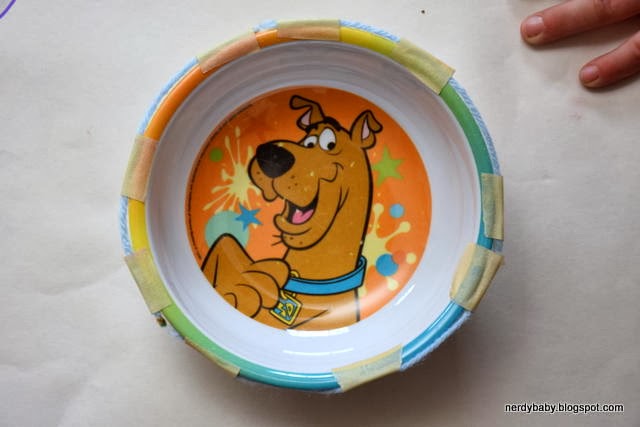
We traced a circular bowl on the paper:


Then we measured the diameter of the circle, three different times, using yarn. What is the diameter of a circle? It's a line that cuts the circle in half, which you can do many (well, infinite) ways. We chose to be satisfied with measuring the diameter three ways. We cut the length of the diameter out of string/yarn:


We compared the length of the strings to see if the diameters were the same:


The diameters are about the same length (we live in an imperfect world and yarn is stretchy and was probably cut at different tensions - and the circle was traced by a four year old).

We then thought it would be easiest to tape the yarn to the outside of the bowl that was traced, along its circumference. We asked J if one piece of yarn, that we had cut to the length of the diameter, would fit all the way around the bowl. His hypothesis: "No!"

He was correct (the string is hard to see in the picture, so we marked the beginning and end with markers, the string is going from purple to red):


Then we asked about 2 pieces of yarn we had cut to the length of the diameter. He wasn't as certain, but he answered "No," again. He was correct, again (the string is going from red to purple, sorry for the inconsistency):


It took all three strings to make it around the bowl (the yarn we used was pretty stretchy and the actual circumference of the bowl was a tad bit smaller than what we had traced).


So how many strings, measured to the length of the circle's diameter, did it take to go around the bowl? About 3! This is approximating Pi! The actual ratio of circumference to diameter length is an irrational number that goes on forever and ever. It starts out 3.14159 and keeps going. For our 4 year old, seeing that Pi is about 3 made this activity a success!


This ratio, Pi, is used to calculate many things like angles and circular motion, but it takes a lot of math to get into that fun stuff. The most common uses of Pi are found in geometry, like finding the: circumference of a circle = Pi*diameter; area of a circle = Pi*(diameter/2)^2, and the volume of a sphere = 4/3*Pi*(diameter/2)^3.

As for our Pi treat and holiday photo, tune in tomorrow to see our creation and annual family Pi Day Photo.


Blog Hop Time! Check out what these fantastic educators are doing about Pi and Pi Day!


We Love Math blog hop is hosted by 

Saturday, March 8, 2014

Pi Day Posters

Let me tell you how excited I am about March 2014. Basically, it's Pi MONTH! 3.14, get it? Why wait till March 14 (also 3.14, in the US, at least) to celebrate? I decided we should get into the nerdy spirit a little early and start decorating.


Pi is the ratio of the circumference of the circle to its diameter. I thought we can have art with circles and numbers to hang above our couch for Pi Day.

Here's what we did:

I convinced J to help me lay out some circular items we had around the house (it helps that I have a lid collection for unknown special occasions). We used bowls, lids, bottle caps, and a tape roll and arranged them on some craft paper. Then we traced each circular item. J was really excited to trace the double circles of the tape.

J is almost 5. He's getting really good at writing his letters and numbers, so I let him write Happy Pi Day and as many numbers of Pi that he had the patience to write. He added a heart (though it looks like a pie with a slice taken out) and "I Love You Pi."


Friday is the official annual Pi Day (March 14 or 3.14...). I will be participating in my first Blog Hop, where a group of bloggers write their own posts about a particular topics and link to other blogs writing about the same topic. Friday's topic: Pi Day!! Make sure to come back for a geometry lesson on circles!

Happy Pi Month to you!

Related Post:

Sunday, February 16, 2014

Mathematical Dice Games


J spent a day sick at home last week. It was a minor illness, so he was very antsy about being inside all day. He pulled out his dice to pass the time. J's great aunt had given him the Tenzi Game (affiliate link) over the summer. We haven't played it the way it's supposed to be played (getting all 10 dice to show the same number, which sounds like some super Yahtzee game), but we now have 40 dice to play with however we want. This is heaven for this math mama! Let me tell you some fun math games we've played with them and how we plan to continue to grow and develop mathematically with the dice.

We started out with each person having their own color of dice, so we can easily distinguish who rolled what.

The Bigger Number Wins!

J actually came up with this game on his own. We started out with one dice (aka. die) each. We rolled the dice, and J first counted the dots on each die and told me which die had the most dots. As we played more, I encouraged J to make his decisions quicker, without counting.

This game is great for older toddlers (who won't shove dice in orifices that they shouldn't be in) and preschoolers to understand the concept of greater than/less than.


Addition: The Bigger Number Wins!

The next game included two dice each. Again, having different color dice is wonderful for determining what numbers belong to each person.

We rolled the dice, and J added up the dots on everyone's rolls. Whoever rolled the biggest number wins! J also ranked who came in second, third, and last. We also increased the frequency of rolls and decreased the amount of time between each roll as we progressed. This challenged our 4.5 year old to make quicker decisions and encouraged more mental math rather than counting dots. In our picture example, the yellow dice wins with 11, green comes in second with 10, white is third with 9, and blue is last with 7.


For older kids: This game can be adapted to use more dice for a greater challenge.


Subtraction: The Smaller Number Wins!

We haven't played this game yet. I imagine it going something like this:

Each player gets two dice of the same color. Everyone rolls their dice and each person's smallest number rolled is subtracted from the larger number rolled. Whoever gets the smallest number wins! In our picture example above, we have a tie for first: yellow and blue both have 1. Green comes in next with 2, and white loses with 3.

For older kids: This can also be a two player game with two dice of different colors each. Pick a color to always subtract from the other color. Note that this might give you negative numbers! The smallest number still wins.


More Math Fun with Dice!


During his childhood, my husband was given a dice game by his grandpa (he has no idea of what it is called). After his old game broke, John went on to design one for himself on his 3-D printer and uploaded it to Thingiverse (to share with other nerdy people). The goal of the game is to use mathematical operations (you know, please excuse my dear Aunt Sally's loud radio - the mathematical order on how you're supposed to solve complex problems parentheses, exponents, multiplication, division, addition, and subtraction from left to right) on the 5 white dice in order to get the result of the two black dice added together (so on the picture above: how would 2, 3, 3, 3, 6 make 42?). If you want more details on the game or want to print one of your own, visit the Dice Game Thingiverse page. This game is also great for older kids.

Do you have any fun math games you play with dice?

Monday, January 20, 2014

Order Numbers and Math

It's no secret that we love In N Out in our family. For those of you who are unfamiliar with this West Coast chain, it's probably the freshest fast food you can get, and it's often very crowded. You order at the counter, and they call your number when your food is ready. J's favorite thing has been to ask, "How many more till our number is called?"

You can do this quick and easy game to pass time at any restaurant where they shout out sequential numbers. At In N Out, the numbers go from 1-99.

John and I don't like to answer, but we turn the tables on J (age 4.5) and make him figure it out. It's hard for a four year old to mentally subtract the smaller number (what was called) from the bigger number (what we have), for example: they called 33 and we were 40; 40-33 = 7, and so we had 7 orders till ours. Instead, we've taught him to count up using his fingers starting with the next number, as in our example above: 33 was called and we want to get to 40, so he finger counts starting with 34 as 1 on his hand, 35 is 2, and so on. He'd stop at 40, which would be 7 fingers he placed up. He's starting to catch on that 30 is 10 away from 40, and he can do the 2-3 numbers away in his head. He loves having the right answer, and it excites me when he's excited about learning (especially math).

However, we only can have the math game when he wants it or else we get, "Mommy, [deep sigh] I don't want to do math right now."

**We've been heavy on the math recently mainly because it requires little-to-no prep work and mess for this pregnant mama. Math and science go hand-in-hand. I encourage you to make both math and science everyday topics of discussions in your household.

Monday, January 13, 2014

Why I Love My Cheap Microwave

It's big, it's blue, and it's bulky. It doesn't match anything in our kitchen, but I've grown to love our cheap microwave. It has been a topic of many conversations and a great math tool! Yes, this is a post about our microwave; please keep reading.


I started college in the fall of 2001 (dated myself). My roommate and I worked out that I'd buy the microwave if she brings the mini fridge. This microwave was in no way unique! In fact, they were all over the place and came in many different colors to suit many different personalities (not to mention, they were the cheapest microwaves out there). When we "temporarily" moved to the Bay Area almost 9 years ago, it came along and just never got replaced because it works just fine. Nowadays, people who never saw these microwaves ask if they were an Apple product of the same general time frame (honestly, I can't blame them for that assumption).

I've recently grown fond of this fine product thanks to the little 4 year old hands that always want to help. The microwave is within his reach, and he'll jump on any task that involves using the microwave.

I'll let you in on my secret on why I love this microwave; we just don't push numbers 0-9 on the key pad and press start. We are given limited options to choose from: 10 minutes, 1 minute, and 15 seconds.


This means J has to think about what to push when I ask him to microwave something for 30 seconds. He quickly learned that 30 is 15 twice and 45 is 15 three times. If I ask him to microwave something for 10 seconds, he watches the microwave and stops it when it says 5 seconds are left. Math is very much a part of our everyday life.

Because of his young age, J's not quite grasping that time (seconds and minutes) are in base 60. We are beginning conversations that 1 minute does not equal 100 seconds and 1 hour does not equal 100 minutes. This microwave will be a useful tool for these conversations too.

Example:

Can you microwave something for 90 seconds given the buttons on our microwave? What would you push? 
(note the 15 seconds only goes to 45 then it goes to 00 without making 1 minute)
  • You could do it in two 45 second waves: 45 + 45 = 90
  • The better choice, assuming the recipe doesn't need 2 - 45 second waves: how many seconds are in 1 minute? 60 (remember the microwave doesn't do 60 seconds but has a 1 minute button). How many seconds remain after you microwave for a minute (which we just established is 60 seconds)? 90-60 = 30. So, the answer is: When microwaving something for 90 seconds, you'd want to set the microwave to 1 minute and 30 seconds by pushing 1 minute and two 15 seconds on our microwave buttons.

What's your favorite nerdy kitchen tool?

*Note, I did prep for this lesson by cleaning out the microwave, a task that I've been putting off for many months. Yay for Nerdy Science and motivation to do my chores.

Wednesday, September 25, 2013

M&M Math - Science Saturday

Sorry for the delay. I had a pretty wicked migraine last week that took me out most of the week.

To recap our September Science Saturday: we had a beautiful Saturday afternoon on the 14th and a great turnout of math lovers (my kind of people).

Now, I created this lesson from a second grade lesson that I only remember had to do with M&M and math (yes, 20+ years ago, when I was in 2nd grade). I wanted to bring it down to the preschool level: basic counting, addition, and I introduced the concept of division (sharing the M&Ms) just to see how well it went over.

Here's what I created as worksheets:
M&M Math Lesson for Preschoolers
M&M Bar Graph

I chose a paper cup full of M&Ms instead of a bag of M&Ms. I was pretty good at scooping out right around 40 M&Ms/cup. The parents guided the kids through the worksheets - surprisingly, the kids were patient enough to do the math before eating the M&Ms.

I had the kids count their M&Ms. The best method was to dump them all out and count them as you put the M&Ms back in the cup:


Then, the kids sorted their M&Ms by color and counted the amount in each color:


Then I had the kids add the primary colors (red, blue, yellow) and then the secondary colors (orange and green since there is no purple). This was exciting for most of the preschoolers since they knew what primary and secondary colors were.

The wild cards were the concept of division and the bar graph. I introduced division as sharing their M&Ms. If you split your M&Ms equally between everyone in your family, how many would each person get? I suggest getting a paper cup for each family member and putting M&Ms one at a time in everyone's cup until the M&Ms are gone. Then count the piles to make sure they are equal. If they aren't, how many are left?


For the bar graph, I made it optional since I wasn't sure of the attention span on the beautiful Saturday. Most kids wanted to do it. I recommend transcribing your color counts below the labels on the x-axis (the colors) and using the same color crayon as M&M to color how many M&Ms of that color you have. I told the kids to find the number on the graph (y-axis), draw a line at that number, and color from 0-the number of M&Ms in that color (I have the axis counting by 5's and put on a minor axis of 1's). The kids were then able to visually assess which color(s) had the most M&Ms.

I hope this is successful for you. We had a lot of fun! It's just in time for Halloween, so feel free to use packets of M&Ms instead of cups of M&Ms. Cups were pretty easy for the bulk necessary for Science Saturday (and most likely classrooms).

P.S. I was asked by parents of really young kids how kids learn how to count (like without skipping numbers or getting stuck in transitions between decades). My answer: practice. J had a hard time, and we just practiced. He can now count to over 100 before getting bored, without mistakes most of the time. Hopefully, you can find and state the patterns as you go along (like from 20-100 everything goes decade+next number ie. twenty-one, twenty-two...and 40-90 sounds just like their unit digit (four-ty, six-ty, etc. though fifty is hard since it's not five-ty)).

Related Posts:

Wednesday, September 11, 2013

Telling Time for Beginners

We picked up this Dr. Seuss foam clock from Target. It was something that J really wanted, and I was hoping we can learn a little more about time from an analog (non-digital) clock.


J has always been an early riser in the morning. We got a digital clock when he was around 18 months, so he can start recognizing numbers, in hopes that he would understand not making a peep until 7:00 am on Saturday mornings. It worked to an extent.

At 4, he can tell us what time the digital clock reads. He is able to say if his school is closed if it's after 6:00 pm. However, he still doesn't understand that the next numbers in minutes after 59 is 00.

So when we saw the clock at Target for $0.50, I figured whynot? It'll at least start the discussion about time.

Points we've discussed so far:
1. The hour hand is the little arrow. Wherever the little hand is first, that's the first number you say. On real analog clocks, the little hand moves slowly to the next number as the big hand ticks away the minutes. This is a little too advance for my 4 year old at this moment. If your kid is grumpy about the little hand not being exactly on 3 when it's 3:30, explain that you take the number you come across before the arrow when going around the clock (ie. if it's between 3 and 4, you get to 3 first when tracing the edge of the clock with your fingers, clockwise).


2. Each of the numbers represents 5. Starting at 1, we are learning to count by 5's around the clock. This is a really hard concept. I don't know how best to explain the numbers and that 1 really means 5 minutes and 2 really means 10 minutes, etc. If you have insight on helping pretty little kids understand minutes of the clock or counting by 5's, I'd appreciate any help.

Reception: J likes to learn about the clock. He'll bring it to me with a time that he sets and asks me to tell him what time it is. We'll work through the problem together, and he typically asks for another time problem. We have yet to get past two separate time telling problems at a time.

You can make your own clock with a paper plate, two arrows (print them out from Word or the internet), and a brad. If you make your own, you can decorate it however you and your child desires.

How have you introduced time telling in your family? Have you been successful?

Tuesday, August 6, 2013

Which cookie would you choose?

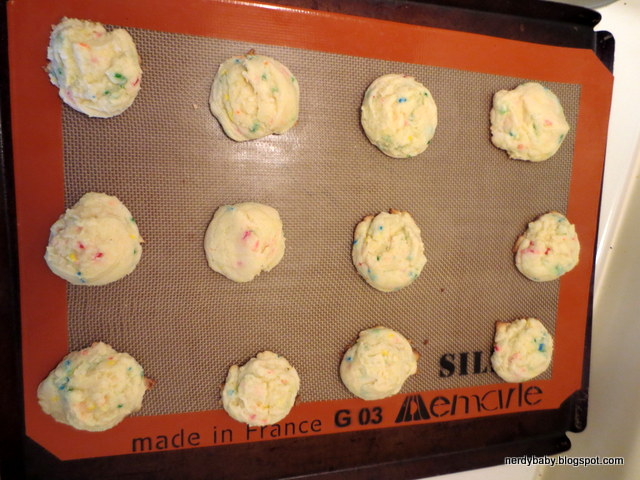
We made cookies for dessert, and J got to select the one he wanted. He took his cookie before I got the picture, but he definitely knows if you only get one cookie, you better select the biggest one for the most pleasureful experience. There was one larger, standout cookie that was the cookie that got the excess batter at the end of the batch.

While helping me dish out how many cookies fit on a pan, we counted 4 rows of 3, which made 12 cookies!


Or is it 3 rows of 4? It's still 12 cookies!!

I love incorporating math into our everyday lives.

Wednesday, June 19, 2013

Math Land Barbie

I'm a nerd. I've always been. I was forced to clean out my parent's house back in March. Since I'm the only one in my family with a kid of my own, I "inherited" all of the board games. Included in the games was one I only semi-remember making in 11th grade trigonometry/pre-calculus. I'm pretty sure it was an assignment though looking back at it, I went waaaaay overboard.

A friend gave me the Dream Date Barbie board game for my 10th bday. It barely got used. When we got this assignment, I thought it would be fun to have something smart related to Barbie. I was willing to sacrifice the board game for the math assignment. I combined it with a new version of Candy Land (which retails under $10) to make the one and only Math Land Barbie.


I used the Barbie and Ken pieces and pasted the Barbie themed tiles over the Candy Land graphics.


All of the Candy Land cards have word problems written on them. The double color cards have double problem sets. I believe they were color coded based on level of problem solving difficulty. I'm sad to admit that some of the questions will need references in order to solve again (luckily there's an answer key, with work shown, that comes with the game!! Time to relearn up through trig/pre-calc math).


Anyone up for a math challenge? Maybe we can play virtually. Otherwise, I'm considering giving the to my littlest bro-in-law who will be majoring in math in the fall for some nerdy dorm fun at college.

A special shout-out goes to Mrs. E. for the fun assignment and math memories.

Tuesday, April 30, 2013

Restaurant Game

We have a hard time determining where to eat as a family. It is our form of entertainment on the weekends. However, we are very routine, and we get sick of eating the same thing over and over. One day, it was taking so long to decide where we were going to go, that we were walking the very thin line of whether we waited too long and J would have a disastrous meltdown. I decided that we were going to play restaurant at home. I'd be the hostess, waitress, and chef. I printed J a menu with a coloring page taken from the internet.

As part of the menu, I gave J a few choices. He had to select one of each group: protein, side/veggies, drink. His favorite menus at restaurants have pictures of the food, so I copied that for our menu. He and his daddy left the house and came in like they were entering the restaurant. I seated them and gave them the menu. J circled what he wanted to eat. I made it and served it.

Kids love to pretend! There's plenty of science in this game too. We talked about nutrition and a balanced meal, along with good choices to help our bodies grow big and strong (not just big). The menu activities can incorporate math games, ie. connect the dots, identifying patterns, etc. J loved this quick thrown together idea that it has become part of our normal week. Yesterday, he requested that he was the waiter and chef. Of course, I supervised him and suggested something that he can do with minimal help (chicken salad sandwiches). He mixed our canned chicken, which I opened, with 3 spoons of light mayonnaise and some cucumber pieces. We calculated how many pieces of bread we needed if mommy, daddy, and J all needed 2 slices each for their sandwiches. He also decided carrots would pair well with the sandwiches. This game also taught J that a lot goes into bringing food to the table and we should be respectful during dinner time.

I can't wait to add more to our game of restaurant. I think as he gets older, we'll start to associate a cost of dining at a restaurant and add money math to the game. ::squeal::

Sunday, March 24, 2013

Patterns, an impromptu lesson

Patterns are everywhere in our life. They are particularly useful in science and are often used to make predictions about what will happen (aka hypotheses). If you can see what is happening, you can use that knowledge to your advantage. It's a great way to start guessing about what's going to happen or come next.

The greatest thing about patterns is that they are super easy to come by. You can make many patterns with pieces of paper (colored, textured, etc), blocks (different shapes and colors), beads, colored pencils/crayons, toys (blue car, red car, blue car...), food (beans, pasta, fruit, veggie, etc), silverware, straws (big straw, little straw, bendy straw), and many more. So next time you're bored waiting somewhere, see if you can challenge your youngin' with what you have at your disposal. Create a pattern and see if they can continue. You can also use a pattern while stacking (I've been known to play the tower game at restaurants back in my day - I haven't yet introduced J to some of my childhood shenanigans).

Here's our short lesson on patterns (which turned into about an hour of pattern making/completing):

Two weeks ago, we were walking home from lunch and found a big box of free items up for grabs. There were lots of books and games. This particular box caught my eyes:


It's definitely not an English game, but it looks like Domino's. I figured this would be fun for science (cause and effect - totally didn't think about patterns).

J immediately requested we played, but it wasn't in the "let's set it up like the picture on the box" way. There were four colors, and J wanted me to make patterns for him to complete.


I tried to convince him that we can make patterns and still build things to knock down too.


Then we found the bobble people the game came with. I think their sole job is to knock things down.


This was one of our more fun evenings over the past few weeks. I'm thankful for this gem of a game we found.

What are some of the ways you have used patterns in your family?

Thursday, March 14, 2013

Happy Pi Day 2013

Rest assure that I am currently sound asleep (or so I hope). I scheduled this to be posted at 1:59a to wish you a very Happy Pi Day (3.14159...)! If you miss it, it's ok to celebrate at 1:59p.


I will be sharing this I <3 Pi pie with my colleagues at work today. The minis will be given to friends.

J and John helped me make the pies. J had a blast with the pie crust: "It's like playdough!" I asked him if he wanted the I <3 Pi pie for his class or if he wanted the chocolate cream, thaw and serve, pie that I bought. Of course, there is no competing with chocolate when it comes to a 3 yr old. Good, because I promised my coworkers a mixed berry pie. I'm actually a little sad that I am missing J's school pi day for the first time since he's been able to eat pie. My normal lab meeting got moved an hour later, making me miss snacktime :-(. I'm sure J will represent Pi Day pretty well on his own (after all it was his first letter he recognized).

We're going to meet one of my good friends from high school for some pi(e) out after school/work today. It's nice to have nerdy friends.

I wish you the Nerdiest of Pi Days!

Tuesday, March 12, 2013

Finger tracing/counting

J came up with this unique way to write his numbers. It starts with 0 up on the top right, then 1, and then he traced his fingers 2-5. 6, 7, 8, 9, and 10 are on the bottom row*. He's so creative.


On the way to dinner today, he repeated a version of his finger counting lesson and squealed with excitement about how much he likes counting. I was pretty excited about his counting too. At dinner, John told J that he (John) doesn't have to count the amount of fingers we hold up, he just knows (based on memorization). We then flashed a few fingers (5 and under) at J and told him to just say how many we were holding up. He did very well with all numbers under 5. Maybe we'll try 10 and under a different day.

*We're still working on the English way of reading and writing.

Friday, February 22, 2013

Egg Maracas

We're approaching Easter. It's a good time to reiterate how much I hate eating just eggs, but I have no problem with using eggs for science experiments. Last year's experiments were fairly extensive, but I'll have some new ones to add this year.

The first one comes from an idea listed on Kiwi Crate's DIY website, Egg Maracas. I enjoyed the idea because somehow we end up with collections of these plastic eggs, and it feels so wasteful to just toss them.


Music is very science oriented. Sound, sound waves, pitch, tone, rhythm, etc all have their place in science. I never played a musical instrument, and I was banned from my elementary school chorus. I stuck to dance, which is deeply rooted in music, in particular rhythm and patterns.

Anyways, the basic maraca is easy to make. For each maraca, we used:
- A plastic egg
- Rice
- 2 matching plastic spoons (we collect these too)
- Masking tape (nothing fancy on our end)


What we did:
1. We filled the plastic eggs with rice. Since we had 3 eggs, we decided to use 3 different amounts of rice to see how that would affect the sound.
2. We taped the eggs shut since they seem to easily split open.
3. We placed the spoons so they cupped the egg and the handles met at the bottom. We needed two sets of hands, one to hold the spoons and the egg and one to tape.
4. While one person holds the spoons and egg in place, the other person tapes around the spoons and the egg (just once should be fine) and down where the handles meet.
5. We covered the whole thing (except Big J's maraca) with tape.
6. We decorated the tape with Sharpies (note that rubbing alcohol takes off Sharpie marker in case you have reservations about handing your little one a permanent marker). Crayola rubs off too easily when placed on masking tape.

Lil J, Big J, and my maracas (from L-R)

Science:
-Guess which egg has the most rice? You can weigh them or listen to the sound difference. A fuller egg should sound deeper.
- Play a "Simon" like rhythm game where you give a pattern of shakes and your kid repeats them. Get more complex as you go. Let your kid be the leader too.
- Use other items instead of rice. How do beans or pennies sound in your shaker?


**I apologize for the poor lighting and Craisins (and much more you don't see) on our kitchen floor. We were invaded by ants, so what's normally in our cupboards is sprawled on our counters, table, and floors. Good news was this experiment was able to be done in a very small space (and impromptu - right before bed).

Saturday, January 19, 2013

Visualizing Numbers 1-100

Early this week, we were driving to our favorite hamburger restaurant with an impatient 3 year old. We told him it would take 5 minutes. He started to count to 5, and both Big J and I began to laugh. We told him 1 minute is 60 seconds. For 5 minutes, he'll have to count (slowly) to 60 five times or 300. To my surprise, he starts to count. The last time he counted aloud he got to 39, so I was surprised to hear him get to 66 without assistance. I helped him with 67 and the 10's after that. We got to 113 when he stated that he wasn't really good at counting. I chuckled and said that he did a VERY good job with his counting.

I have to admit that I was thoroughly impressed with how far he got with very little prompting, but I knew then what my next lesson was going to be! I got home and created a chart of numbers 1-100 for J using Excel. I decided to start with 0 and go with the 10's on the top, so everything in that column would have the same first part of the number (ie. twenty, twenty-one, twenty-two, etc).

I waited till this morning to print it out.

I used another sheet of paper and covered the columns (the vertical set of numbers) except for the 1's column. I called J over to look at the numbers. I pointed at the numbers in order, and he stated the number. Then I had him guess what comes after 9 (10), and I uncovered the next column (the 10's). I continued to have him guess the next column until 70 (where he was having difficulties a few days ago). I uncovered the 70's before he got to it. He didn't need prompting with any numbers until 100!

I knew he knew the numbers visually, 0-10, but I wanted to see if he could recognize larger numbers if I wrote them out. I wrote out 25 on the piece of paper I used to cover the columns in the previous part of the lesson. He knew the numbers separately, but he couldn't say it was "twenty-five". We found 25 on the chart and counted from 20 (which he recognized) down to 25. This led to another lesson, addition. 43 is 40+__ (three). He caught onto this concept fairly easily, so it was easier to find the bigger number on the chart. We did that with a few other numbers.

Other numbers we had him find on our chart: all of our ages, how old we'll be after our birthdays this year, grandma and grandpa's ages, and how old they'll be after their birthdays this year.

How do you help your little one understand numbers and sequences?

Friday, December 21, 2012

Candy Cane Division, Addition, and Multiplication

A box of candy canes comes with a dozen candy canes. That's 12 candy canes.

If everyone in our family (mommy, daddy, and J) want the same number of candy canes with no leftovers, how many would we each get?

Who gets it? - each gets 1 per time their name appears (the number in parentheses is the # of candy cane from the box)

Mommy (1)
Daddy (2)
J (3)

Mommy (4)
Daddy (5)
J (6)

Mommy (7)
Daddy (8)
J (9)

Mommy (10)
Daddy (11)
J (12)

Now count how many are in each person's pile. Everyone should have 4 candy canes. You just divided 12 by 3.

If we combine Mommy's and J's piles we have 2 piles of 4 candy canes, or 8 candy canes altogether. Count to be sure your calculations are correct. This is addition (4+4) or multiplication (2x4).

If we combine all three of our piles, we have 3 piles of 4 candy canes, or 12 candy canes altogether. Count to be sure. This is addition (4+4+4) or multiplication (3x4).

Now, you can decorate the tree or eat the candy canes depending on your family's preference.

I hope your holiday season is full of joy and happiness and that you have a great New Year.